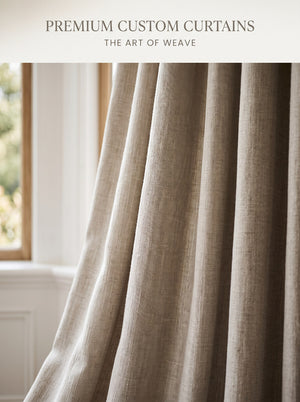
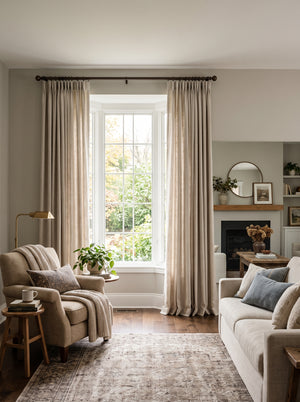
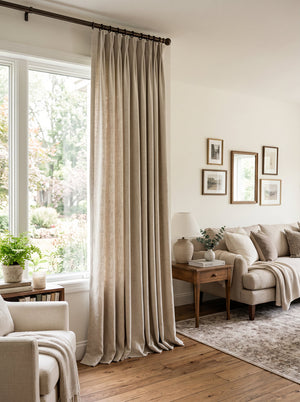

Measure once, and give your custom drapery the finish it deserves.
This page is built to walk your customer through the exact steps that matter most: where to start the measurement, how wide to go, how to choose the finished drop, and what mistakes to avoid before ordering custom curtains.
Good drapery starts with accurate measurements.
Measure every window separately, even if they look identical. Always measure the full area you want the curtain to frame, not only the glass itself. Before taking the final size, decide whether you are mounting on a rod, a track, the wall, or the ceiling, because the mounting method changes the final look and the finished drop.
Step 1: Measure the full width correctly.
Measure the full visual span
Do not stop at the glass. Measure the entire area you want the curtains to visually frame so the final window treatment feels intentional and properly scaled.
Extend beyond the window
For a more custom look, extend 8 to 12 inches beyond each side when space allows. This makes the window feel larger and keeps more natural light visible when panels are open.
Think about stack-back
For wider openings and patio doors, plan enough room so open curtains can stack back cleanly without covering too much glass.
Step 2: Measure the finished height from the real mounting point.
Start from the true hardware line
Measure from the bottom of the rod, the bottom of the track, or the exact ceiling line where the curtain will actually hang.
Measure both sides
Floors and ceilings are not always level. Always confirm the left and right side of the window before choosing the final finished length.
Use your intended floor finish
Your final drop depends on whether you want the curtain to float, kiss the floor, or softly puddle. Choose that first, then calculate the final height.
Choose the floor finish before you place the order.
Hangs slightly above the floor for a cleaner, more modern look and easier daily maintenance.
Just touches the floor for the most tailored and universally elegant custom finish.
Extends onto the floor for a softer, more decorative, more romantic effect.
If your customer is unsure, a kiss finish is usually the safest choice. It looks polished, photographs beautifully, and works across the largest range of interiors.
Step 3: Avoid the measuring mistakes that make custom curtains look ordinary.
Do not measure only the glass
This almost always makes the finished curtain feel too narrow, too flat, and visually under-scaled for the room.
Do not choose the drop before the hardware
The final length depends on the hardware style and installation point, so hardware decisions should come before the final curtain length.
Do not assume matching windows are identical
Always confirm each window individually. A small difference in height or floor level can be very visible once custom drapery is installed.
A few careful measurements now will create a result that looks taller, fuller, and far more considered later.
Use this guide to help shoppers feel confident before they order. It reduces hesitation, prevents easy mistakes, and makes the custom process feel more elevated and professional.
Still unsure about width, height, or the best finished drop?
Invite customers to contact you before ordering if they want a second opinion. That extra support makes the buying experience feel high-touch and lowers the chance of ordering errors.